Whatsapp
  X
X  Mail
Mail  Copy link
 Growing Asparagus crop nutrition advice
Everything you need to know about Asparagus fertilization, best practice, field trials, and more.
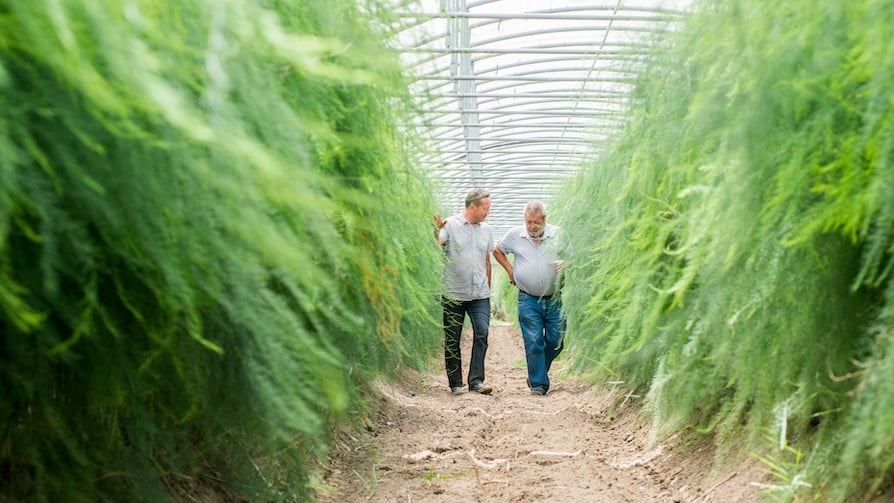
Monitoring Asparagus Growth in the Greenhouse
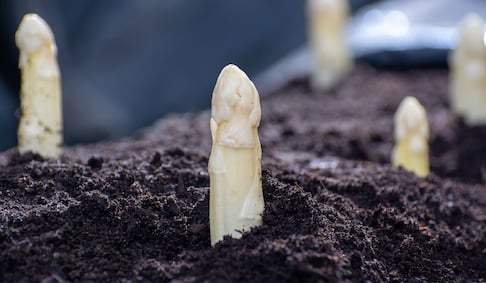
White Asparagus Breaking Through the Soil
Introduction
Origin & crop type: Perennial vegetable native to coastal Europe/North Africa/West Asia. Commercial production uses crowns (1–2-year-old) or transplants; spears are harvested annually, typically for 6–8+ years per planting.
Market types: Green asparagus (commonly blanched aboveground), white asparagus (etiolated—grown under ridges/tunnels to prevent greening), and violet types.
Global significance & producers: According to FAOSTAT data for 2022, global asparagus production reached approximately 8.82 million tonnes, with the top producing countries as follows:
| Country | Production (Mt) | Share of Global Production |
|---|---|---|
| China | 7.68 | 87.1% |
| Perú | 0.38 | 4.3% |
| Mexico | 0.30 | 3.4% |
| Germany | 0.11 | 1.2% |
Productivity notes: Perú and Mexico lead in productivity per hectare, averaging 11,670 kg/ha and 9,430 kg/ha, respectively, compared to average yields of 5,344 kg/ha in Asia and 5,010 kg/ha in Europe.
Uses & quality drivers: Fresh, bundled spears, minimally processed, and frozen. Quality = spear diameter/length uniformity, tight tips, low fiber (lignification), color (green/white), and shelf life.
Key Cultivation Challenges
| Challenge | Description |
|---|---|
| Stand longevity & vigor | Crown health, root diseases (Fusarium), carbohydrate reserves, and nutrition/water balance |
| Spear quality | Heat/cold spells, irrigation timing, N:K:Ca balance, harvest frequency |
| Soil constraints | Compaction, salinity/sodicity in arid regions, pH extremes |
| Pests/diseases | Asparagus beetles, Fusarium crown/foot rot, Phytophthora in wet soils, rust (humid) |
| Weeds | Perennial weeds and grasses; crucial to control in establishment years |
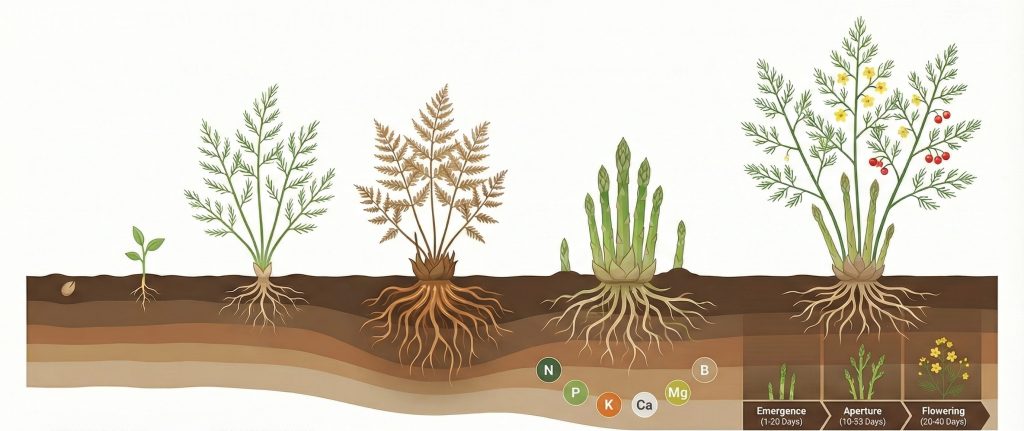
Asparagus Growth Stages and Nutrient Uptake from Germination to Flowering
Plant Growth Environment
Soils
- Best on: Well-drained sandy loam–loamy soils; avoid prolonged saturation
- pH target: 6.5–7.2 (tolerates ~6.0–7.8). Lime if <6.2; elemental S or acidifying fertigation if >7.8 (gradual)
- Organic matter: Improves tilth, aeration, and crown/root health. Avoid fresh manures near harvest windows (food safety)
Climate
- Perennial crowns: Require cool/cold dormancy; spear emergence begins as soils warm (~10–12 °C+)
- Optimal spear growth: ~15–24 °C; heat accelerates growth and fiber formation; cold snaps can cause tip loosening/physiological disorder
- White asparagus: Requires earthing-up/ridging or light-excluded tunnels
Water Management
- Deep, extensive roots once established; uniform moisture supports spear quality and carbohydrate recharge post-harvest
- Irrigation systems: Drip or sprinklers work; avoid chronic wet feet (root rots)
- Irrigation quality: ECw ideally <0.8–1.0 dS/m; manage Na, Cl, HCO₃⁻ in arid zones
Salinity and Sodicity
- Moderate sensitivity: Yield and spear quality decline with rising ECe (~>2 dS/m, yield declines ~9% per additional dS/m.”)
- Management: Leaching fractions, gypsum for sodic soils, and blending water sources
Nutrient Roles & Symptoms
Macronutrients
| Nutrient | Key Roles | Deficiency Symptoms | Excess / Interactions |
|---|---|---|---|
| N | Spear growth, fern biomass, carbohydrate recharge | Pale ferns, thin spears, low yield | Excess = overly ferny growth, lodging, delayed hardening; disease susceptibility |
| P | Root and crown development, energy transfer | Stunting, poor rooting, dull and blue-green ferns | Very high P can induce Zn/Fe issues on high-pH soils |
| K | Osmotic balance, stress tolerance, spear firmness | Marginal scorch/chlorosis, weak spears, lodging | High K can depress Mg and Ca uptake |
| Ca | Cell walls, membrane integrity, spear tip quality | Tip deformation, weak tissue | Low mobility in plant—delivery depends on water flow |
| Mg | Chlorophyll, enzymes | Interveinal chlorosis (older ferns) | Antagonized by high K/Ca |
| S | Proteins, amino acids | Uniform yellowing (newer tissue), slow growth | Excess can acidify soilless media |
Micronutrients (B, Fe, Mn, Zn, Cu, Mo)
| Micronutrient | Key Roles | Deficiency | Excess / Notes |
|---|---|---|---|
| B | Cell wall and meristem integrity; spear formation | Deformed spear tips and fern growing points, brittleness | Narrow sufficiency range—avoid over-application |
| Fe | Chlorophyll enzymes | Interveinal chlorosis (newest ferns), high-pH risk | Chelated Fe in high-pH systems |
| Mn | Photosynthesis/redox | Interveinal chlorosis with speckle (young–mid tissue) | Can be excessive at low pH |
| Zn | Enzymes, auxin | Small leaves, shortened internodes | Less available at high pH |
| Cu | Lignification, enzymes | Distorted young tissue, dieback | Low demand; avoid repeated foliar Cu |
| Mo | N reduction | Chlorosis under high nitrate feeding at low pH | Deficiency more common in acidic soils |
Quality impacts: Adequate K and Ca improve spear firmness and shelf life; balanced N supports yield without excessive fiber; B:Zn: Fe balance helps tip integrity and fern health.
Growth Stages & Nutritional Needs
Perennial Cycle Overview
- Establishment (Year 0–1): Crown/transplant establishment, root and fern growth (no or limited harvest)
- Build & first harvests (Year 2–3): Short spring harvest, then full ferning to recharge crowns
- Full production (Year 4+): Spring (and in some regions fall) harvests, followed by fern growth until frost/dieback
- Dormancy & residue management
Typical Nutrient Demand (Open Field)
Note: Split and time according to stage and region.
Typical Nutrient Demand (Open Field)
| Stage | N | P₂O₅ | K₂O | CaO | MgO | SO₃ |
|---|---|---|---|---|---|---|
| Establishment year (no harvest) | 60–100 | 40–60 | 80–120 | 40–80 | 20–30 | 20–40 |
| Early production (short harvest) | 80–120 | 30–50 | 100–150 | 40–80 | 20–30 | 20–40 |
| Full production (typical season)* | 100–200 | 30–60 | 120–300 | 60–120 | 25–40 | 25–50 |
*In some varieties, nitrogen consumption is higher because they require more leaf mass to sufficiently develop the root zone and to accumulate carbohydrates.
*The nitrogen balance is important in the final stage of crop, where an excess can cause new shoots that will reduce productivity.
*It is especially important to maintain good levels of calcium and potassium at the beginning of plant senescence, so that the plant remains healthy and has time for the translocation of carbohydrates to the roots.
Application Methods
- Pre-plant/bed prep: Correct pH; apply P, K, Ca per soil test (band/incorporate); organic amendments well ahead of planting
- In-season (post-harvest ferning): Apply/split N and K to rebuild crowns; fertigation (drip) improves uniformity
- Foliar (targeted): B, Zn (deficiency risk on high pH); Fe chelates in high-pH soils/media; Ca foliar has limited systemicity but can help tip quality when tissue tests indicate risk
Tissue Testing (Fern Stage, Indicative Ranges)
| Nutrient Category | Nutrient | Sufficiency Range |
|---|---|---|
| Macronutrients (% DW) | N | 2.0–3.2 |
| P | 0.2–0.4 | |
| K | 2.0–3.5 | |
| Ca | 0.6–1.2 | |
| Mg | 0.25–0.6 | |
| S | 0.2–0.4 | |
| Micronutrients (mg/kg DW) | B | 25–50 |
| Fe | 60–200 | |
| Zn | 20–60 | |
| Mn | 40–300 | |
| Cu | 5–20 | |
| Mo | 0.2–1.0 |
Climate Change Impacts on Crop Nutrition
- Heat waves: Accelerate spear emergence (more frequent harvests) but increase fiber/lignification and tip opening; maintain adequate K/Ca and irrigate to cool soils
- Erratic rainfall: Greater leaching of N/S; split N and consider controlled-release fertilizers or fertigation. Maintain drainage to reduce Phytophthora risks.
- Elevated CO₂: Can boost fern biomass; ensure balanced K, Mg, and micronutrients to avoid dilution effects
- Salinity pressure (arid regions): Monitor EC, Na, and Cl; schedule leaching fractions; gypsum for sodic soils; consider salt-tolerant cultivars where available
References
- FAOSTAT. Crops and Livestock Products—Asparagus (latest available)
- USDA. Vegetable & Pulses Yearbook, production statistics
- UC ANR / UC Davis. Asparagus production and pest/disease management guidelines
- Cornell Cooperative Extension; Michigan State University Extension. Perennial asparagus nutrition and production notes
- Wageningen University & Research; University of Florida IFAS. Vegetable production and soil/water management resources
- FAO. Irrigation and Drainage Paper 56 (ETc); FAO Guidelines on salt-affected soils
- INRAE / EMBRAPA / CSIRO (regional resources on soil health, salinity, and vegetable systems)
Other interesting trials
Guides & Articles
For more information
Q&A
Here are some frequently asked questions we received from farmers regarding growing Asparagus.
Split N—little to none during intensive harvest; focus on post-harvest fern growth to recharge crowns (often 2–3 splits). Adjust total N to yield potential and soil tests.
It is important not to apply nitrogen too late, so as not to stimulate new spear shoots that do not contribute to carbohydrate accumulation.
Often both. Over-harvest, heat spikes, and low K/Ca or inadequate moisture drive thin/fibrous spears. Shorten the harvest interval in heat, maintain uniform soil moisture, and verify K/Ca sufficiency.
Watch Zn, Fe, and B. Maintain pH near 7.0; use chelated Fe if needed; consider banding Zn; avoid excessive P, which worsens Zn availability.
Test ECe/ECw/SAR. Blend water if possible, program periodic leaching fractions, add gypsum for sodic soils, and avoid saline irrigation near planting/early establishment.
Potassium and calcium are important throughout the entire crop cycle, including the productive stage and plant development. A moment that is not usually considered and is important is to maintain good levels of calcium and potassium at the beginning of plant senescence, so that the plant remains healthier and has time for the translocation of carbohydrates to the roots.
Discover Our Solutions for Growing Asparagus
Asparagus Solutions: Increase Your Harvest
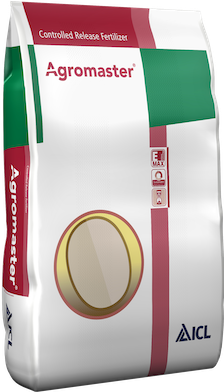
Agromaster®
Nutrient & Unit Converter
Access calculators to improve nutrient management and boost productivity
More crops
Grow Better, Every Season