Whatsapp
  X
X  Mail
Mail  Copy link
 Enhancing Sustainability with Fertigation
Fertigation lowers nitrogen emissions of crop production, improving the crops carbon footprint.

On this page:
Fertigation – the precise delivery of nutrients through irrigation – offers an effective way to boost crop productivity while reducing nitrogen losses and greenhouse gas emissions. This article highlights how fertigation improves nutrient-use efficiency, supports soil and water conservation, and lowers agriculture’s carbon footprint. By integrating smart fertigation systems, growers can achieve sustainable yields and advance climate-resilient farming.
What Is Fertigation in Agriculture?
Fertigation is the practice of delivering fertilizers to crops through irrigation water, combining irrigation and nutrition in a single, efficient system. By applying nutrients directly when and where crops need them, fertigation improves nutrient use efficiency and reduces waste compared with conventional fertilizer practices. While drip irrigation, for example, may be used as the delivery method, the two are not the same: drip irrigation focuses on water use, while fertigation extends this principle by also providing precise plant nutrition.
This precision has important implications for sustainability. Agriculture plays a vital role in feeding the world, but it is also a significant source of greenhouse gas emissions. Using precise fertilizer application techniques, such as fertigation, helps address this challenge by reducing nutrient losses, cutting nitrous oxide emissions, and supporting more efficient food production.
When we look at the overall greenhouse gas emissions caused by human activities, agriculture is estimated to be responsible for nearly 50% of the methane emissions, 60% of nitrous oxide emissions, and 3% of the carbon dioxide emissions. In total, agriculture could be responsible for up to 15% of today’s total warming, according to the IPCC 2019 Climate Change and Land Report.
There are multiple sources of greenhouse gas emissions from agriculture, including methane from ruminant livestock, emissions from deforestation to create new agricultural land, or N2O emissions from manure left on pastures. But there are also emissions due to the manufacture, transport, and use of fertilizers.
Nitrogen for Crop Nutrition
Plants require 17 different nutrients to thrive, with the three main nutrients being nitrogen, phosphorus, and potassium. Of these, nitrogen is, in many respects, the most important. Nitrogen is essential for crop production, with a crucial role in the formation of proteins, enzymes, and chlorophyll.
Each nutrient, including nitrogen, has an environmental cost in addition to its financial cost for the grower. The manufacture, transport, and application of fertilizers all result in the production of greenhouse gases. These are divided into three types of emission which can be broadly described as:
- Scope 1: emissions from the production of the fertilizers
- Scope 2: emissions from the production of the energy used
- Scope 3: emissions from the use of fertilizers.
As a fertilizer manufacturer, ICL is working to improve the sustainability of our business, reducing our carbon footprint and we have started publishing details of the footprint of our products (Scope 1). Publishing this information provides growers with an opportunity to reduce the greenhouse gas emissions related to the manufacture of the fertilizers they use by selecting Low-CO2 fertilizers with a low product carbon footprint (PCF), but that is only part of the equation. Research into the emissions from nitrogen fertilizers has shown that approximately two-thirds of the emissions occur after fertilizer is applied in the fields (Scope 3). These emissions may be, for example, the result of over-application, poor application timing, inefficient application method, or imbalanced nutrient application.
Excess application of nitrogen can result in nitrous oxide (N2O) emissions. Nitrous oxide is a significant greenhouse gas, with each kg having an equivalent environmental impact to 298 kg of carbon dioxide. As a result, ensuring optimum nitrogen application will improve the sustainability of agriculture.
Increasing Nitrogen Use Efficiency in Sustainable Agriculture
The good news is that tools are available to help improve the nitrogen use efficiency of crop production and, hence, reduce nitrogen losses, potentially reducing agriculture’s overall greenhouse gas emissions.
If we examine the different fertilizer application methods, we find that fertigation is effective in increasing a crop’s nutrient use efficiency.
How Fertigation Reduces Nitrogen Emissions and Carbon Footprint
Because fertigation delivers nutrients directly with irrigation water, it ensures that crops receive the right nutrients in the right amounts at the right time. Water-soluble, liquid, or liquid suspension fertilizers are mixed with the irrigation water to deliver nutrients to the plants. Fertigation is developed from micro irrigation systems that were created to make the best use of limited water resources. Extending irrigation systems to deliver nutrients creates versatile and efficient methods of nutrient application that are increasingly popular worldwide.
While fertigation systems are most common in high-value fruit, vegetable, and salad crops, they are increasingly being adapted for all crops, including broad-acre arable crops. The targeted nature of fertigation application, typically only 20-30% of the total soil volume is wetted, reduces nutrient losses. Also, as growers can adjust the nutrient mix at any time to match the crop’s needs, the nutrient use efficiency of crop production increases.
Compared with conventional fertilizer practices, fertigation significantly lowers the risk of nitrous oxide (N2O) emissions, which are nearly 300 times more potent than carbon dioxide as a greenhouse gas, resulting in efficiency gains while achieving the same, or higher, levels of crop performance.
Fertigation vs. Conventional Fertilizer Practices – Key Differences
The reduction in nitrous oxide emissions can be substantial and can potentially result in a significant reduction in Scope 3 emissions. A study published in the Global Change Biology journal found that applying nitrogen through drip irrigation significantly reduced N2O emissions by 32% compared to furrow irrigation systems and by 46% compared to sprinkler irrigation, leading the researchers to suggest that drip irrigation should be recommended as an essential N2O mitigation strategy for irrigated crop production.
These findings are supported by research from the USA which examined nitrogen emissions from tomato crops. The paper, published in the Agriculture, Ecosystems and Environment journal, measured the nitrous oxide emissions from two different fertilizer management strategies.
- Conventional system: furrow irrigation and side-dress fertilizer applications
- Integrated system: drip irrigation, reduced tillage, and fertigation
The difference, once again, is quite clear. The total weighted growing season N emissions from the integrated system were less than 30% of the conventional management practice’s emissions, while at the same time, the tomato yield from the fertigation system increased.
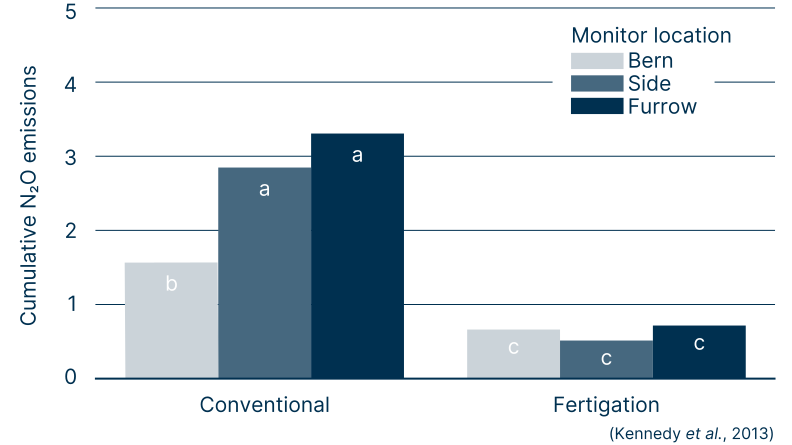
The precise control and application of nutrients with fertigation minimizes excess fertilizer use and reduces nitrogen volatilization. It also ensures crops benefit from the optimum balance of nutrients they need to achieve this reduction in greenhouse gas emissions while also improving crop quality and crop productivity.
Fertigation Efficiency Reduces GHG Emissions
Fertigation is a precise technique to deliver nutrients, improve crop yield, and reduce nutrient losses. With approximately two-thirds of the greenhouse gas emissions taking place after fertilizer application as Scope 3 emissions, the reduction in nutrient losses and improvement in nutrient use efficiency from fertigation fertilizer applications indicate fertigation’s potential to reduce agriculture’s greenhouse gas emissions and increase sustainability.
Referenced documents
- Gao, Y., Cabrera Serrenho, A. (2023), Greenhouse gas emissions from nitrogen fertilizers could be reduced by up to one-fifth of current levels by 2050 with combined interventions. Nat Food 4:170–178 doi.org/10.1038/s43016-023-00698-w
- IPCC 2019 Climate Change and Land Report
- Kennedy T.L., Suddick E.C., Six J. (2013), Reduced nitrous oxide emissions and increased yields in California tomato cropping systems under drip irrigation and fertigation. Agriculture, Ecosystems & Environment, 170:16-27 doi.org/10.1016/j.agee.2013.02.002.
- Kuang, W., Gao, X., Tenuta, M. and Zeng, F. (2021), A global meta-analysis of nitrous oxide emission from drip-irrigated cropping system. Glob Change Biol, 27: 3244-3256 doi.org/10.1111/gcb.15636

Related crops