


 Whatsapp
  Facebook
  Mail
Mail  Copy link
 Autumn pansies and primroses – get a head start

On this page:
Designing the correct growing media for autumn pansy and primrose crops can streamline production and support consistent, high-quality results, says Brendan Howell.
Whether using peat-reduced or peat-free mixes, both the structure and fertigation programme must be adapted for autumn conditions.
Tailoring your peat-reduced media
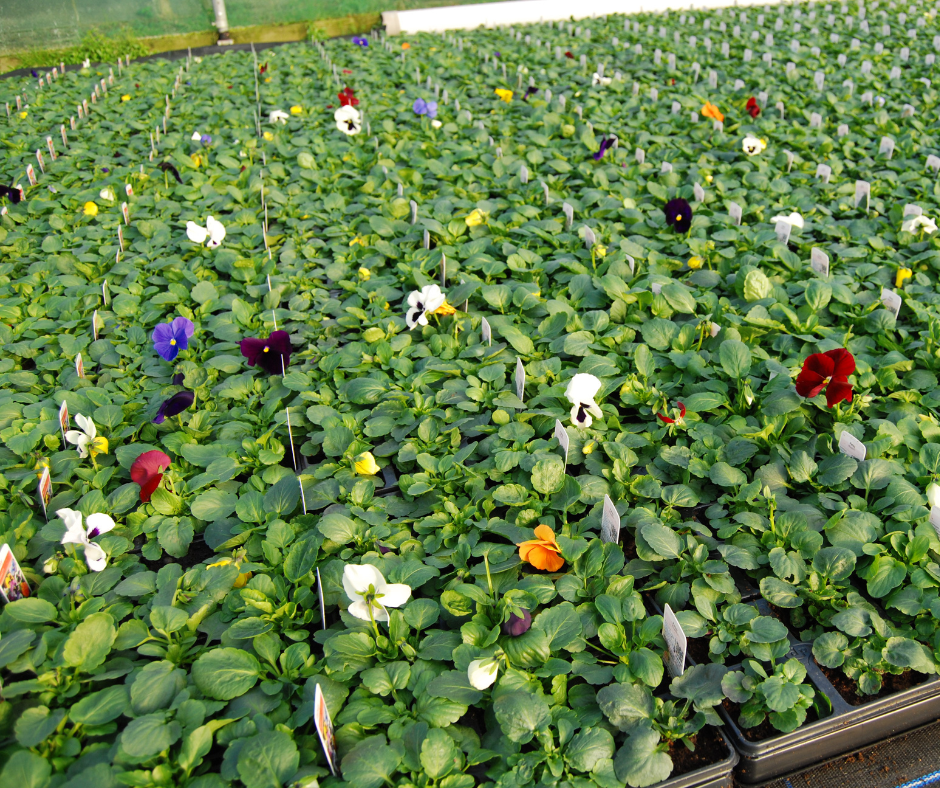
Pansies and other autumn bedding crops require an autumn bedding mix that holds water well and has a good nutrition package.
While working at a large Lincolnshire bedding plant producer, I grew pansies in a peat-reduced Levington Advance mix incorporating a fine grade of Fibagro® Advance woodfibre at 30% minimum. This kept the structure open, allowing water to penetrate so that plants rooted out well and grew evenly.
While this mix incorporated a base fertiliser PG mix and trace element package, I would still supplementary feed at least once a week with Universol® Orange. Applied weekly for the first three weeks post-planting, it helped ensure the pansies remained heathy and continued to grow well to the sales programme.
Depending on sales levels, later in the autumn I would sometimes switch to Universol Violet to toughen the crop up for winter.
Disease management is also critical. Root rots can be addressed effectively by incorporating the biofungicide Prestop® into your Levington Advance Solutions mix. Prestop also offers some suppression of Ramularia, though a robust fungicide programme remains essential.
Primroses are often grown in standard bedding mixes, but in my experience, a bespoke growing media blend yields superior results. Primroses require a media that retains adequate moisture without over-saturation, as excess water can lead to root issues. They are also nutritionally demanding, particularly in terms of iron.
To meet these needs, I recommend using higher rates of Micromax® Premium, our fine granular trace element fertiliser, within the growing media. Supplementary applications of Micromax® WS Iron – typically twice during the crop cycle – can also help prevent or rectify iron deficiency.
Of course, incorporating controlled release Osmocote® 5 (5-6 month) or Osmocote Exact High K (5-6 month) – which promotes quality flowering and compact growth – will greatly simplifies the production process, saving time and labour fertigating the crop. Again, you may need to provide some extra iron as this crop is quite demanding.
Turning to pests and diseases, while whitefly and aphids can be a problem in Primroses – Botrytis is probably the primary issue. This can be due to the crop being too wet or planted too deep. Again, by implementing a robust spray programme this problem can be avoided.

Peat-free – water little and often
When growing peat-free, the core principles remain similar. However, irrigation must be adjusted: water more frequently with shorter cycles to reduce nutrient leaching. Depending on the season, an additional weekly feed or a continuous low-level feed may be necessary.
All Levington Advance mixes include H2Gro®, our wetting and water-conservation agent that enhances water distribution and uptake. In peat-free Levington Advance Sustain blends, the H2Gro rate is doubled to offset the lower water-holding capacity of coir or woodfibre ingredients.
For tailored advice on your autumn bedding crops, contact Brendan Howell.

Our knowledge
Tips & tricks, disease prevention, crop and market related information
Explore our knowledge