Whatsapp
 X
X
 Mail
Mail
 Copy link
 Bi-monthly applications of H2Pro TriSmart save manpower
links golf course fairway turf, North West England
Key Conclusions
This trial demonstrates that a wetting agent program can contribute to turf quality by maintaining improved rootzone VMC% through periods of dryness for tee or fairway type turf in a links golf course setting. A bi-monthly schedule of applications could deliver both significantly improved turf quality over untreated areas through summer stress and recovery periods as well as reduce water needed for application, irrigation water needed for watering wetting agents in and save time and money by reducing the number of applications needed.
Summary
- A trial was conducted on a links golf course fairway turf in the North West England during 2023.
- H2Pro TriSmart was compared at two rates; monthly at 10L/ha (6 applications) and bi-monthly at 20L/ha (3 applications) both applied in 700L water.
- The trial ran from 4th April to the 18th September. Fortnightly assessments of turf quality were assessed visually on a 1-10 scale and VMC % taken at 3.8cm and 7.6cm depths were made.
- Both wetting agent programs provided a significant (P<0.05) improvement over control plots for mean turf color and mean VMC% at both depths.
- There were no significant differences between the two wetting agent programs during the trial which suggests a bi-monthly approach could be utilized to make a significant saving on labor and resources.
Objective
To compare turf quality and rootzone moisture content following two H2Pro TriSmart programs; reduced frequency, double rate applications and label rate, monthly applications.
Trial Details
Trial station
links golf course fairway turf, North West England
Product
TriSmart
Assessments
Mean visual turf quality, volumetric moisture content and plant health and performance.
Treatments
A wetting agent trial was set up on fescue-dominated, tee-quality turf at a links golf course in North West England. Treatments were applied to 1m x 1m plots in a randomized-block trial design with 4 replications (Table 1). The trial started on 4th April for 22 weeks ending on 18th September. Fortnightly assessments of turf quality (assessed visually 1-10 scale) and volumetric moisture content % (VMC%) at two depths; 3.8cm (1.5 inches) and 7.6cm (3 inches) using a Spectrum Fieldscout TDR350 soil moisture meter.
| Treatment name | Application rate (L/ha) | Application interval (weeks) | Water volume (L/ha) |
|---|---|---|---|
| Control, Untreated | N/A | N/A | N/A |
| H2Pro TriSmart - monthly | 10 | 4 | 700 |
| H2Pro TriSmart - bi-monthly | 20 | 8 | 700 |
Treatments
A wetting agent trial was set up on fescue-dominated, tee-quality turf at a links golf course in North West England. Treatments were applied to 1m x 1m plots in a randomized-block trial design with 4 replications (Table 1). The trial started on 4th April for 22 weeks ending on 18th September. Fortnightly assessments of turf quality (assessed visually 1-10 scale) and volumetric moisture content % (VMC%) at two depths; 3.8cm (1.5 inches) and 7.6cm (3 inches) using a Spectrum Fieldscout TDR350 soil moisture meter.
| Treatment name | Application rate (L/ha) | Application interval (weeks) | Water volume (L/ha) |
|---|---|---|---|
| Control, Untreated | N/A | N/A | N/A |
| H2Pro TriSmart - monthly | 10 | 4 | 700 |
| H2Pro TriSmart - bi-monthly | 20 | 8 | 700 |
Results
The application of H2Pro TriSmart at both monthly (10L/ha) and bi-monthly (20L/ha) significantly (P<0.05) increased mean visual turf quality over the control on 5 of 13 measurement occasions (Figure 1). Both applications of TriSmart also increased VMC% in the rootzone during periods of dryness and drought stress, with 4 occasions being significantly different (P<0.05) to the control at 3.8cm, and 3 occasions at 7.6 cm (Figures 2 & 3). This demonstrates the ability of applications of H2Pro TriSmart to maintain a higher VMC% of the rootzone during periods of dryness and so potentially improve plant health and performance. Comparisons between the two H2Pro TriSmart programs in place illustrate that at no time is there a significant difference between the monthly and bi-monthly program for mean visual turf quality or mean VMC% at 3.8cm or 7.6cm. This suggests that either program would be acceptable for managing tee or fairway type turf and potentially utilizing a bi-monthly program would reduce resources (fuel and water) used and operator hours to make a considerable club saving and contribute to a reduction in carbon emissions.
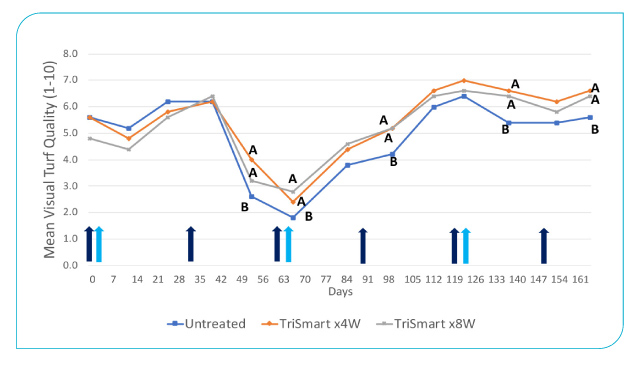
Mean turf quality (1-10). Letters signify a comparative significant difference. Dark blue arrows denote applications on a monthly program, light blue arrows denote applications on a bi-monthly program.
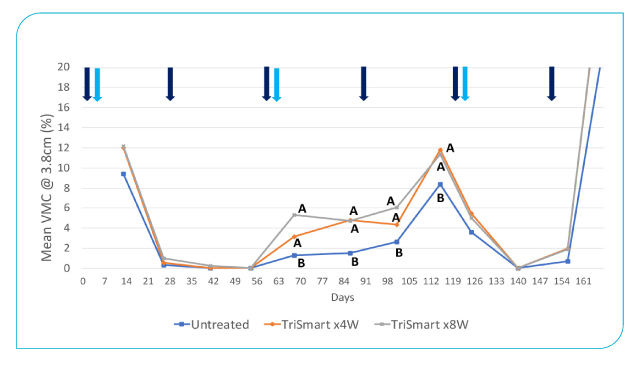
Mean rootzone VMC% at 3.8cm. Letters signify a comparative significant difference. Dark blue arrows denote applications on a monthly program, light blue arrows denote applications on a bi-monthly program.
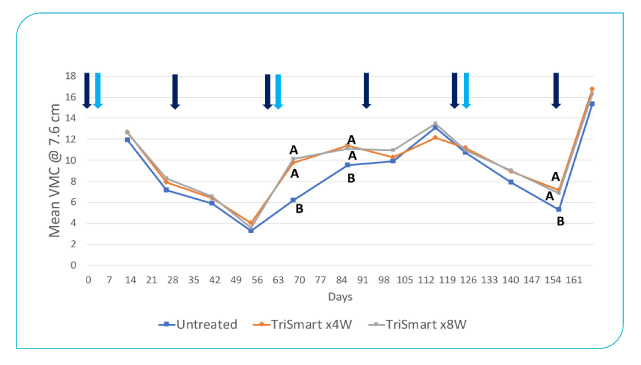
Mean rootzone VMC% at 7.6cm. Letters signify a comparative significant difference. Dark blue arrows denote applications on a monthly program, light blue arrows denote applications on a bi-monthly program.