Whatsapp
 X
X
 Mail
Mail
 Copy link
 Polysulphate® Cauliflower Trial in India
Yield Increase
Hessaraghatta, Karnataka, India 2014
Yield Increase
Key Conclusions
The highest yield was obtained with a full dose of NPK and 75% sulfur (S) dose delivered through Polysulphate (T4), which gave rise to a 39.5% increase in the yield of cauliflower.
Objective
To test the efficacy of Polysulphate as a sulfur source on the performance of cauliflower (Brassica oleracea var. botrytis) in India.
Trial Details
Trial station
Hessaraghatta, Karnataka, India
Crop
Cauliflower
Product
Standard Polysulphate 0-0-13
Assessments
Yield, quality, growth parameters, and nutrient uptake
Treatments
The experiment was laid out in a randomized block design with 3 replicates and included 6 treatments:
- T1: Control without S and K fertilization (100% NP through urea and DAP only)
- T2: 100% NPK (urea, DAP, Muriate of Potash (MOP))
- T3: 100% NP + 50% S through Polysulphate (10 kg S/ha) (balanced K through MOP to make 100% K)
- T4: 100% NP + 75% S through Polysulphate (15 kg S/ha) (balanced K through MOP to make 100% K)
- T5: 100% NP + 100% S through Polysulphate (20 kg S/ha) (balanced K through MOP to make 100% K)
- T6: 100% NPK (urea, DAP, MOP) + 100% S through gypsum (20 kg S/ha)
The recommended dose of fertilizers: 150 kg N, 100 kg P2O5, 125 kg K2O/ha and 20 kg S/ha was applied as per the treatments. Farmyard manure (FYM) was also applied at 25 t/ha in the last plough.
Treatments
The experiment was laid out in a randomized block design with 3 replicates and included 6 treatments:
- T1: Control without S and K fertilization (100% NP through urea and DAP only)
- T2: 100% NPK (urea, DAP, Muriate of Potash (MOP))
- T3: 100% NP + 50% S through Polysulphate (10 kg S/ha) (balanced K through MOP to make 100% K)
- T4: 100% NP + 75% S through Polysulphate (15 kg S/ha) (balanced K through MOP to make 100% K)
- T5: 100% NP + 100% S through Polysulphate (20 kg S/ha) (balanced K through MOP to make 100% K)
- T6: 100% NPK (urea, DAP, MOP) + 100% S through gypsum (20 kg S/ha)
The recommended dose of fertilizers: 150 kg N, 100 kg P2O5, 125 kg K2O/ha and 20 kg S/ha was applied as per the treatments. Farmyard manure (FYM) was also applied at 25 t/ha in the last plough.
Results
- S application significantly contributed to increased yield and quality (curd diameter and compactness at harvest) of cauliflower.
- S application in the form of Polysulphate, up to 75% of the recommended S dose (T4), enhanced plant growth and development, improving plant height and number of leaves.
- N, K, Ca, and S uptake by cauliflower crop was highest when S was applied in the form of Polysulphate, up to 75% of the recommended S dose (T4).
- The highest yield was obtained with a full dose N-P-K and 75% S dose delivered through Polysulphate (T4), which gave rise to 39.5% increase in the yield of cauliflower, compared to the non-fertilized control (T1).
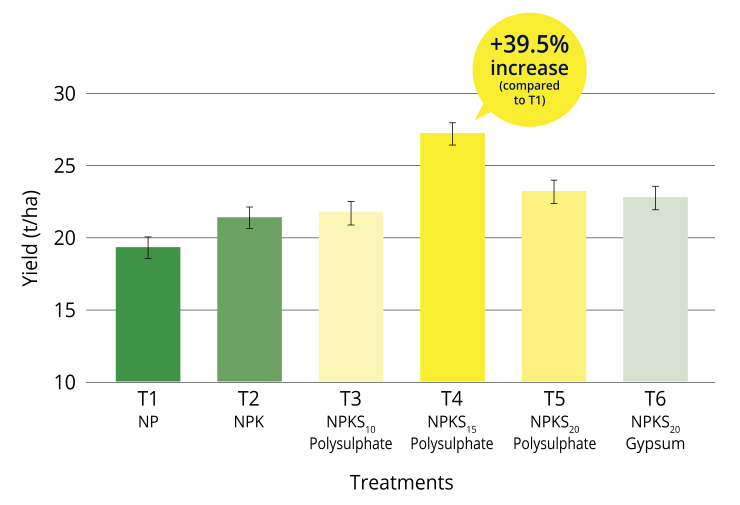
Delivering 75% of S with Polysulphate increases cauliflower yield by 39.5%.
Bars indicate LSD at P<0.05.
* From research funded by the International Potash Institute www.ipipotash.org
Other Interesting Trials
Polysulphate®